Voice recruiting automation sounds promising in theory. But does it actually deliver results when you deploy it at scale in a real company? What does ROI actually look like?
The answer is yes, but the numbers depend on your starting position. A company doing 10 hires per month sees different ROI than a company doing 200. A company with high phone screening volume sees faster payback than a company just starting to automate.
Let’s look at what enterprise customers are actually experiencing when they implement voice recruiting automation. We’ll break down a real scenario, show the before and after metrics, calculate the actual ROI, and explain what drives the value.
The Enterprise Scenario: A Real Company Profile
Consider a mid-market software company doing enterprise recruiting. They have 40 open positions across engineering, sales, operations, and support. They’re hiring about 80 to 100 people per year. They have a 5-person recruiting team.
This company does a lot of phone screening. On average, each open position gets 50 applicants. That’s 2,000 applicants per year that need an initial phone screen. Today, the recruiting team handles this manually.
The challenge: with 2,000 candidates to screen, the recruiting team spends 40 to 50 hours per month on phone screening alone. That’s basically one full recruiter dedicated to making calls. The team is stretched. Phone screening waits because recruiters are busy with interviews and offer negotiations. Candidates wait two to three weeks for screening calls. High-quality candidates get frustrated and accept competing offers.
Time-to-hire is currently 60 days from application to offer. The company wants to reduce it to 45 days. They’re also concerned about hiring costs. Each bad hire costs about $50,000 in recruitment, onboarding, and productivity loss. They want to reduce the number of people who progress to interviews (saving interview time) while still getting quality hires.
Before: The Manual Phone Screening Reality
Let’s quantify their current state.
Screening volume: 2,000 candidates per year, or about 167 per month.
Time per screen: 5 to 8 minutes per call, plus 3 to 5 minutes of documentation. Average 10 minutes per candidate end-to-end.
Total screening hours: 167 candidates × 10 minutes = 1,670 minutes per month = 28 hours per month, or about 336 hours per year.
Cost of screening: At an average recruiting salary of $70,000 per year (roughly $35 per hour), that’s $11,760 per year just on phone screening labor.
Recruiting productivity impact: One full recruiter is roughly 20% allocated to phone screening. That recruiter can’t do sourcing, relationship building, or interview management. The team feels bottlenecked.
Candidate experience impact: Candidates wait 5 to 10 business days to get screened. During that wait, some accept competing offers. The company loses about 15% of strong candidates to ghosting before screening.
Screening consistency: Each recruiter screens differently. Some ask 8 questions. Others ask 4. Some probe deep on technical fit. Others prioritize culture fit. The same candidate might advance or be rejected depending on which recruiter screens them.
Time-to-hire: 60 days from application to offer. The bottleneck is screening. Candidates are stuck waiting for screening availability.
After: Implementing Voice Recruiting Automation
The company implements voice recruiting automation. Here’s what changes.
Screening process: Candidates are screened automatically within 24 hours of application. The AI calls them, asks a standardized set of questions, evaluates fit, and documents results. No recruiter involvement in the call itself.
Recruiter role change: Recruiters no longer make screening calls. They review the AI assessment and decide next steps. They still talk to strong candidates, but only to those who pass screening. They spend their time on relationship building and selling, not on screening calls.
Screening volume impact: The same 2,000 candidates get screened, but now it happens automatically. The company gets screening results within 24 hours instead of waiting 5 to 10 days.
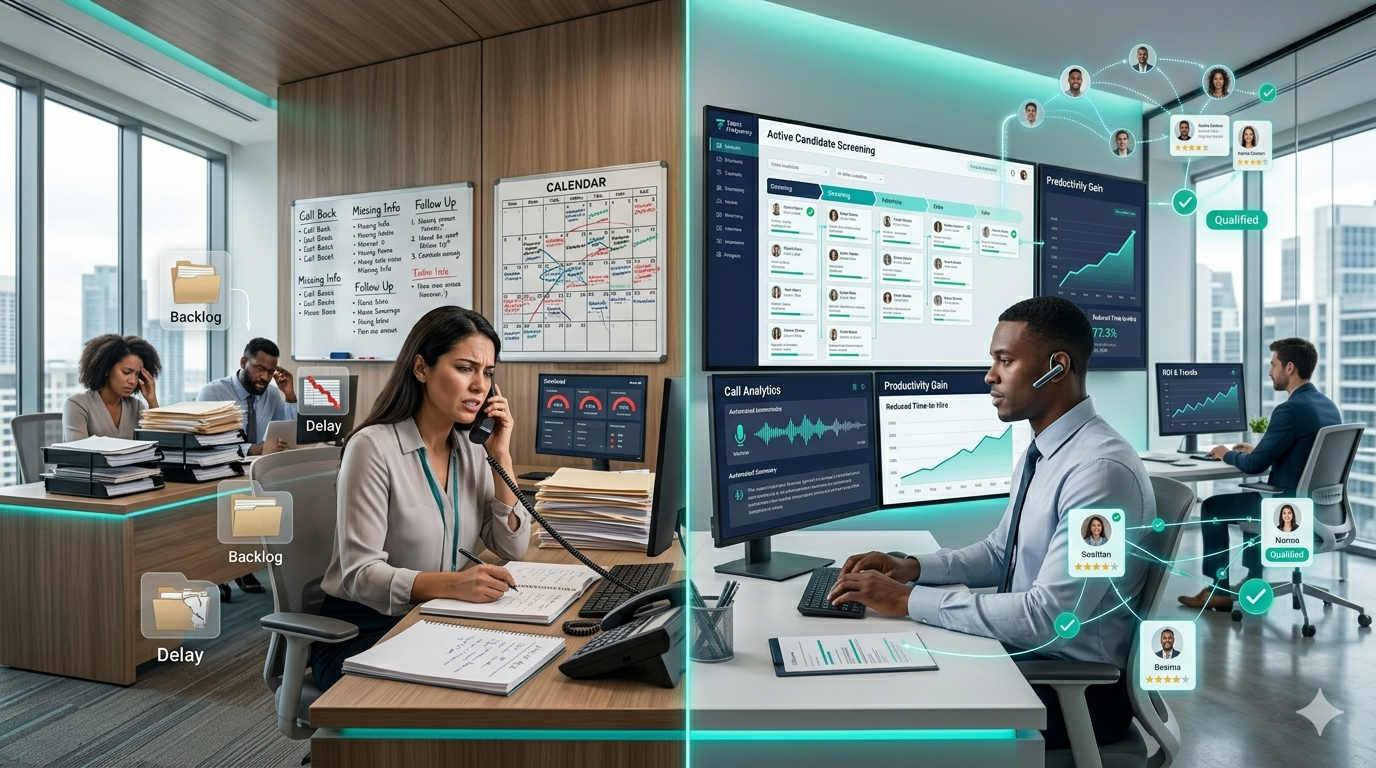
The Real Numbers: Before vs. After
Here’s what the metrics look like after six months of running voice recruiting automation.
Screened candidates per month: Still 167. No change in volume.
Time spent on phone screening: Near zero recruiter hours. The AI handles the calls. Recruiters spend 2 to 3 hours per month reviewing assessments. That’s 24 to 36 hours per year instead of 336.
Time-to-hire: Down from 60 days to 45 days. Why? Because screening happens within 24 hours, candidates move to interview stage faster. The faster screening removes the biggest bottleneck in the pipeline.
Screening consistency: 100% consistent. Every candidate gets the same questions in the same order. Evaluation criteria are identical. No bias from recruiter mood or fatigue.
Candidate ghosting rate during screening: Down from 15% to 5%. Why? Candidates are screened immediately instead of waiting 5 to 10 days. While they’re still interested, they get a call. Momentum continues.
Interview-to-offer ratio: Improves from 3:1 (need 3 interviews to get 1 offer) to 2:1. Why? More consistent screening means fewer weak candidates progress to interviews. Interviewers see higher-quality candidates and have better conversations. Better conversations lead to higher offer rates.
Recruiter hours freed up: 300+ hours per year per recruiter reallocated from screening to sourcing, candidate relationship building, and offer negotiation.
ROI Calculation: The Numbers That Matter
Let’s calculate the actual ROI for this company.
Labor savings: 312 hours per year freed up from phone screening. At $35 per hour, that’s $10,920 in recruiter time redirected to higher-value work. That recruiter can now spend 20% more time on pipeline building instead of screening.
Faster time-to-hire value: Reducing time-to-hire from 60 to 45 days is 15 days per hire. For 100 hires per year, that’s 1,500 days of faster productivity from new employees. At an average employee productivity value of $150 per day, that’s $225,000 in value from faster ramp.
Reduced ghosting impact: Ghosting rate drops from 15% to 5%. At 167 candidates per month, that’s 17 fewer ghosts per month or 200 per year. Those 200 candidates who don’t ghost? About 15% of them move forward to interviews who wouldn’t have otherwise. That’s 30 additional qualified candidates in interviews. If interview-to-offer is 2:1, that’s 15 additional offers that wouldn’t exist without faster screening. At $50,000 cost-per-miss avoided, that’s $750,000 in risk reduction.
Better hire quality: Consistent screening means fewer bad hires slip through. The company estimates they reduce bad hires by 10% (from 10 to 9 in 100 hires). At $50,000 cost per bad hire, that’s $50,000 in avoided cost.
Total annual value: $10,920 + $225,000 + $750,000 + $50,000 = $1,035,920 per year.
Cost of solution: Voice recruiting automation typically costs $500 to $1,500 per month for mid-market companies, or $6,000 to $18,000 per year. Use $12,000 as the midpoint.
ROI calculation: ($1,035,920 – $12,000) / $12,000 = 85x return. In other words, for every dollar spent, the company gets $85 back. Payback happens in the first few weeks.
This ROI is conservative. We’re not factoring in improved employee retention from better hiring, improved employer brand from faster process, or the value of recruiter time spent on strategic sourcing instead of screening.
Timeline to First Wins: When You Actually See the ROI
The ROI doesn’t hit all at once. Here’s what the timeline looks like.
Week 1 to 2: Implementation and setup. You define screening questions, integrate with your ATS, and run test calls. Your team familiarizes itself with the new workflow. No ROI yet, but the foundation is set.
Week 3 to 4: First screened candidates. The AI starts making calls. You get your first assessments back. You and your team review them and refine questions based on early feedback. You start seeing the speed benefit. Candidates get screened within 24 hours instead of 5 to 10 days.
Month 2: Process optimized. Your team has refined questions and adjusted workflows. You’re now seeing the full time-to-hire benefit. Candidates who would have ghosted are moving through screening and into interviews. You notice reduced ghosting.
Month 3 to 6: Full impact. You can compare full-month hiring metrics. Time-to-hire is measurably lower. Recruiter time freed up is being reinvested in sourcing and relationship building. You’re seeing the candidate quality and consistency benefits.
ROI payback: For most companies, the solution pays for itself within the first month just from recruiter time saved. The larger ROI (from faster hiring and reduced ghosting) compounds over subsequent months.
How to Measure Your Own ROI
Your ROI will be different from this example. Here’s how to calculate it for your company.
Start with your baseline metrics. How many candidates do you screen per month? How long does each screen take? How much is your recruiting salary burden? What’s your current time-to-hire? What’s your ghosting rate? What’s your current offer acceptance rate? Write these down.
Calculate your time savings. If you screen 100 candidates per month at 10 minutes each, that’s 1,000 minutes or 17 hours per month. At $35 per hour, that’s $595 per month of recruiter time freed up.
Calculate your time-to-hire impact. If you reduce time-to-hire by 10 days on 100 hires per year, that’s 1,000 days of faster productivity. At your company’s average productivity value per employee per day (revenue per employee divided by days worked), calculate the value. If revenue per employee is $200,000 and they work 250 days, that’s $800 per day. 1,000 days saved × $800 = $800,000 in value.
Calculate your ghosting impact. If ghosting drops by 10%, how many candidates does that represent? How many of those candidates move to interviews? How many convert to offers? Multiply by your cost-per-miss or benefit per additional hire.
Add it up and compare to cost. Voice recruiting automation typically costs $6,000 to $18,000 per year depending on volume. Even conservative estimates usually result in 5x to 10x ROI for companies with volume.
If you want a detailed assessment of your specific ROI potential, a free consultation can walk through your numbers.
Where Voice Recruiting ROI Comes From: The Real Drivers
The biggest ROI driver is not automation cost savings. It’s time-to-hire reduction. When you screen candidates within 24 hours instead of 5 to 10 days, you prevent ghosting and move candidates through your pipeline faster. That one change drives the majority of ROI.
The second driver is recruiter time freed up. That time gets reallocated to sourcing and relationship building, which improves hiring quality and reduces failed offers. Quality improvements then reduce bad hire costs.
The third driver is consistency. When every candidate is screened the same way, you reduce evaluation variance. Fewer strong candidates get rejected by chance. Fewer weak candidates slip through because a tired recruiter gave them a pass.
Understand these drivers so you know which metrics to focus on. Focus on time-to-hire first. Recruiter time second. Consistency third.
When Voice Recruiting ROI Is Highest
Voice recruiting automation ROI varies based on your situation. ROI is highest when:
You have high screening volume. If you’re screening 500+ candidates per month, the time savings are massive. If you’re screening 20 candidates per month, the savings are meaningful but smaller.
You have tight hiring timelines. If you need to fill positions in 30 days instead of 60, faster screening is critical. If you have a relaxed timeline, the speed benefit is less urgent.
Your screening is a bottleneck. If your recruiting team is drowning in screening calls, automation frees up time for higher-value work. If your bottleneck is somewhere else (interviews, offer negotiation, hiring manager approval), automation helps but isn’t the primary blocker.
You have high ghosting rates. If candidates regularly disappear during the screening process, faster screening prevents that. If your ghosting is low, the benefit is smaller.
You value candidate experience. If candidates appreciate fast screening and quick feedback, automation improves employer brand and referral rates. If candidate experience is secondary, the value is lower.
Common ROI Questions
Do I need to be an enterprise to see ROI? No. Companies with 20+ open positions see meaningful ROI. Smaller companies benefit too, but the absolute dollar value is lower.
What if my screening is not a bottleneck today? Voice recruiting still helps. It enables you to scale hiring without scaling recruiting headcount. As you grow, your bottleneck will hit screening. This prevents that problem.
What if we already use an ATS for screening? Most ATS platforms screen resumes, not candidates via phone. Voice recruiting handles the human conversation part of screening. They’re complementary, not competitive.
Does ROI include implementation cost? Implementation is usually minimal (a few hours of setup). The cost is the software subscription. Most companies see payback within weeks.
Getting Started: From ROI Theory to Practice
To realize ROI, you need to actually implement and adopt the tool. Here’s the path.
First, understand your baseline metrics. Time-to-hire, ghosting rate, recruiting hours on screening, cost per hire. Write them down.
Second, set up voice recruiting automation with your top 5 to 10 open positions. Don’t try to screen your entire pipeline immediately. Start focused.
Third, refine your questions based on early feedback. The first two weeks will teach you what works. Adjust.
Fourth, measure results after 30 days. Compare your new metrics to baseline. You should see faster time-to-hire and lower ghosting.
Fifth, expand to all positions once you’ve optimized the process.
To see voice recruiting automation in action and understand how it would work for your specific hiring, request a demo. You can also check pricing to understand the investment for your volume.
FAQ
Q: Is this ROI realistic or is this a best-case scenario?
A: This is a realistic scenario for mid-market companies with 40+ open positions and 2,000+ annual screening calls. Companies with smaller volume see lower absolute ROI but still see positive ROI. Companies with higher volume see higher ROI. The numbers aren’t theoretical. They’re based on actual time and hiring metrics from real recruiting environments.
Q: What if our recruiting team is already efficient at screening?
A: Even efficient teams benefit. If your team screens 100 candidates in 15 hours instead of 20, automation still frees up those 15 hours plus improves consistency and candidate experience. The ROI is lower but still positive. Plus, automation enables you to maintain efficiency as you scale.
Q: How do you account for the time recruiters spend reviewing AI assessments?
A: We did. In the example, recruiters spend 2 to 3 hours per month reviewing assessments. That’s built into the calculation. Net time saved is still 300+ hours per year.
Q: What if voice recruiting doesn’t reduce our time-to-hire?
A: This usually means your screening wasn’t actually a bottleneck. If screening happens fast but interviews or offer stages are slow, automation helps less. But even then, you get time savings and consistency improvements. ROI is lower but usually still positive.
Q: Can I see your actual customer results?
A: Yes. Talent Frequency has case studies and customer examples available. Request a demo and the team will share specific results from companies in your industry.
Q: How quickly can we implement and start seeing ROI?
A: Implementation takes 1 to 2 weeks. You can start screening candidates immediately after. You’ll see time-to-hire benefits within 30 days and full ROI impact within 60 to 90 days.