Bias in recruiting is real. Studies show that identical resumes get different callback rates based on the name on the resume. A resume with a traditionally Black name gets callbacks at [NEEDS SOURCE]% the rate of an identical resume with a traditionally white name. A resume with a woman’s name gets fewer callbacks for technical roles than the identical resume with a man’s name.
This bias starts at resume review and continues through phone screening and interviews. Different interviewers evaluate the same candidate differently. One interviewer thinks a candidate is confident. Another thinks they’re arrogant. One thinks a candidate is detail-oriented. Another thinks they’re anxious. Same candidate, different evaluations.
This bias has real consequences. You hire the wrong people because you’re influenced by their name or appearance or communication style instead of their actual qualifications. You reject good candidates because they don’t fit your mental model of what the role “should be.” You end up with a less diverse team and poorer hiring decisions.
But here’s the good news: you can reduce bias significantly. The antidote to bias isn’t good intentions. It’s structure. When you standardize your questions, remove human judgment from initial evaluation, and enforce consistent criteria, bias drops dramatically.
Voice recruiting automation is one of the most effective tools for reducing bias because it enforces standardization at the critical screening stage.
How Bias Gets Into Your Recruiting Process
Unconscious bias. You don’t intend to discriminate. But humans have mental shortcuts that make us biased. A candidate has a name you don’t recognize. Your brain assumes they might not be a culture fit. A candidate has a gap in their resume. You assume they’re flaky. A candidate is nervous during their phone screen. You think they’re not confident enough. These shortcuts are unconscious and automatic. But they affect your hiring decisions.
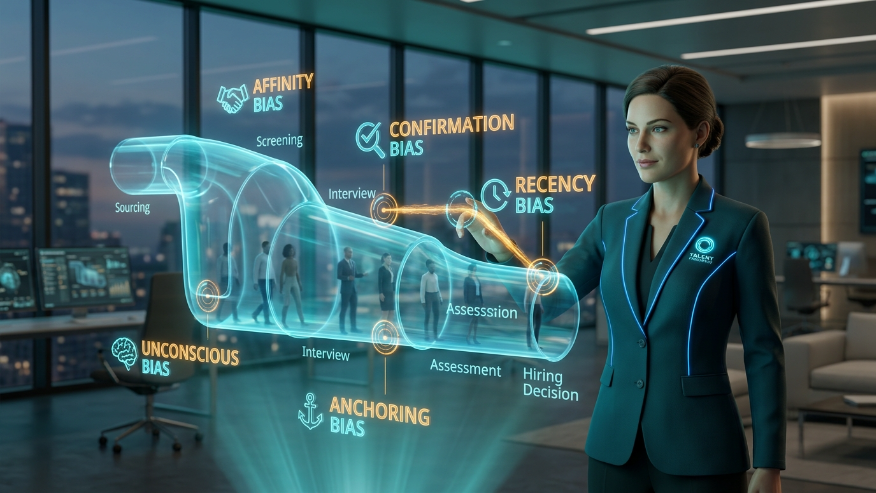
Affinity bias. People like people who are similar to them. If your interviewer is a 30-year-old engineer who went to Stanford, they’re more likely to favor a 30-year-old engineer from Stanford. The candidate reminds them of themselves, so they rate them higher. This happens without the interviewer realizing it.
Confirmation bias. You form an initial impression of a candidate. Then you look for evidence that confirms that impression. If you think a candidate is strong, you interpret their vague answer as “thoughtful.” If you think they’re weak, you interpret the same answer as “unclear.” You’re seeing what you expect to see, not what’s actually there.
Recency bias. You interview five candidates in a row. By candidate five, you’re tired. You’re not evaluating candidate five as fairly as you evaluated candidate one. Fatigue affects judgment. The timing of when you meet a candidate affects how you rate them.
Anchoring bias. The first candidate you interview sets your baseline. If they’re really strong, every subsequent candidate seems weaker in comparison. If they’re weak, everyone else seems stronger. The order of interviews affects your evaluations.
These biases aren’t personal flaws. They’re human. But in recruiting, they lead to discrimination and poor hiring.
The Impact of Bias on Your Hiring
You hire less qualified people. Bias causes you to favor candidates who remind you of people you’ve successfully hired before, or people like you. You might pass over more qualified candidates because they don’t fit your mental model. Result: weaker hires.
You lose diverse talent. Bias affects how you evaluate candidates from underrepresented backgrounds. You might interpret their communication style as not culture fit when it’s just different. You might assume they’re not technical enough when they actually are. Result: less diverse team, which means less diverse perspectives and innovation.
You create legal risk. If you’re rejecting disproportionate numbers of candidates from protected classes, you’re creating legal exposure. Even unintentional discrimination is discrimination. Lawsuits are expensive and damaging to your reputation.
You build worse culture. A homogeneous team (because you hired people like you) is less creative and less resilient. Different backgrounds bring different perspectives. Homogeneous teams have groupthink. That leads to worse decisions.
You damage employer brand. If candidates feel they were discriminated against, they tell people. Word spreads. Your reputation as an unfair employer spreads. Recruiting gets harder.
Bias costs you in hiring quality, diversity, legal risk, and culture. It’s not just a values issue. It’s a business issue.
How Structured Questioning Reduces Bias
The antidote to bias is structure. When your screening process is structured, bias has less room to operate.
Every candidate gets the same questions. Structured screening means you ask candidate A the same questions you ask candidate B. No skipping questions because you like candidate A. No extra deep dives on candidate B because you’re skeptical. Same questions. This removes the bias that comes from unequal evaluation.
Questions focus on job requirements, not culture fit or personal style. A biased question might be: “Tell me about yourself.” That opens the door to cultural and personal style bias. A structured question is: “Describe your experience with [specific tool or skill]. What projects did you use it on?” That focuses on job-relevant information.
You’re evaluating answers, not the person. In an unstructured screening, you’re evaluating the person. How they sound. How confident they seem. Whether you’d grab coffee with them. In structured screening, you’re evaluating their answer to your question. Did they have the experience? Can they do the work? This separates job fit from personal preference.
Documentation creates a record. When you document what a candidate said in response to your structured questions, you create accountability. You can’t later claim they didn’t mention something if your notes show they did. You can’t rationalize a rejection if your criteria were clear and documented.
Structured questioning alone significantly reduces bias. When you pair it with AI, bias reduction goes even further.
How AI Voice Recruiting Removes Bias
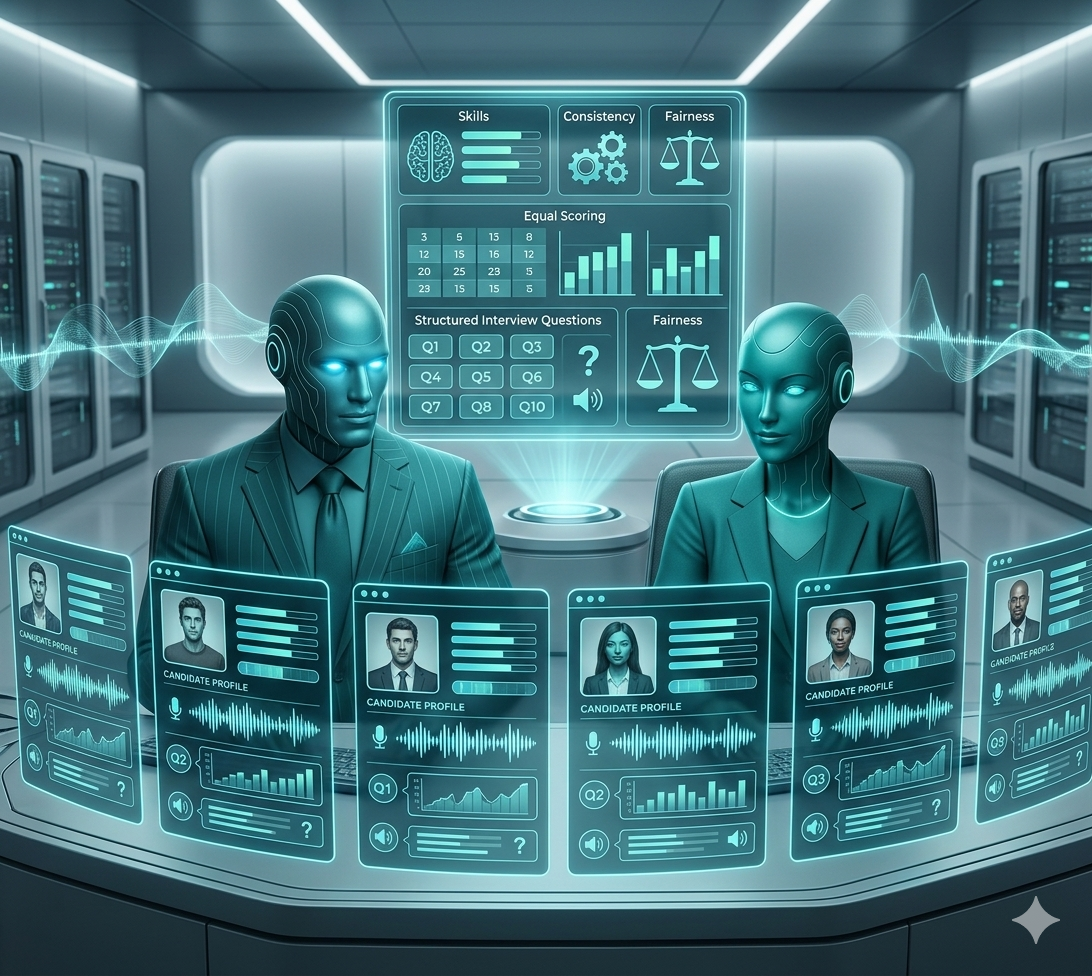
AI voice recruiting reduces bias in four ways:
1. Perfect consistency. The AI asks the exact same questions in the exact same way to every candidate. No recruiter fatigue affecting the quality of later interviews. No affinity bias because the AI has no preferences. No recency or anchoring bias because each conversation is independent. Every candidate gets evaluated the same way.
2. No tone-based judgment. In a human phone screen, tone of voice affects evaluation. A candidate is nervous. Their voice shakes. A human recruiter might interpret that as lack of confidence. The AI doesn’t judge tone. It evaluates the content of the answer. A nervous candidate and a confident candidate answering the same question get evaluated on the same criteria.
3. Blind evaluation.** The AI doesn’t know the candidate’s name, background, or demographic information while asking questions. It evaluates based purely on answers. This removes name bias and background bias. You can’t unconsciously discriminate against someone you don’t know anything about except their answers.
4. Documented decision criteria.** The AI assessment is based on your pre-defined criteria. You defined what “passes screening” means before the calls began. The AI evaluates against those criteria. There’s no subjective judgment. There’s no “I have a gut feeling about this candidate.” There’s clear criteria, applied consistently.
The result: AI screening is dramatically less biased than human screening.
The Data on Bias Reduction
Research shows that structured interviews reduce bias significantly. [NEEDS SOURCE: specific percentage reduction from academic research]
In practice, companies implementing voice recruiting automation report: [NEEDS SOURCE: specific customer metrics on bias reduction]
What we know from research is that bias reduction comes from three mechanisms:
Standardization reduces bias. When you standardize your process, you remove discretion. When you remove discretion, you remove the places where bias enters. Standardized tests are fairer than subjective evaluation. This is well-established in research.
Documentation increases accountability. When you document your decisions and criteria, you’re less likely to discriminate. You know someone might ask “why did you reject this candidate?” So you make sure your criteria are fair and your decision is defensible. Documentation enforces fairness.
Consistency reduces disparate impact. Disparate impact is when your process, even if not intentionally discriminatory, has a disparate impact on protected classes. For example, if your process rejects 60% of candidates from one demographic and 20% from another, that’s disparate impact. Consistency means you reject 30% of candidates from all demographics. No disparate impact.
Companies that implement structured screening with AI report improved diversity in their pipeline. Not because AI is inherently woke. But because AI removes the discretionary points where bias enters.
Why This Matters for Your Company
Reducing bias isn’t just ethically right. It’s strategically smart.
Better hiring decisions. When you remove bias, you make better hiring decisions. You hire people who can actually do the job instead of people who remind you of successful hires in the past. You expand your candidate pool. You find better talent.
More diverse teams. Diverse teams are more innovative. They make better decisions. They have lower turnover. They attract better talent (people want to work on diverse teams). Diversity is a business advantage.
Legal protection. When your process is standardized and documented, you have legal protection. If you ever face a discrimination claim, you can show: here’s our process, here’s how we applied it consistently, here’s the documentation. You can defend yourself.
Employer brand. Candidates want to work for companies that are fair. When your recruiting process feels fair and professional, candidates respect you. Even candidates you don’t hire. They tell their networks “that company was fair and professional in how they evaluated me.” That becomes your reputation. That attracts talent.
Implementing Bias-Reducing Screening in Your Organization
Step 1: Define your role requirements. Not “culture fit.” Not “smart” or “ambitious.” Specific job requirements. For an engineer: “3+ years of experience with [tech stack].” For a recruiter: “2+ years of recruiting in SaaS.” Be specific about what matters for the role.
Step 2: Create structured questions. Map your requirements to screening questions. For each requirement, write a question that assesses it. “Tell me about your experience with [specific tech]. Describe a project where you used it and what your role was.” Not “tell me what you’re good at.”
Step 3: Define pass/fail criteria. Before you screen anyone, define what passes screening. “Candidate passes if they have 3+ years in [tech] OR equivalent demonstrated experience in similar stack.” Be explicit. Not “if I feel like they know [tech].”
Step 4: Document everything. Every screening call, document the candidate’s answers to your questions. Document your assessment. Document your decision and reasoning. This creates the record that prevents bias from sneaking in later.
Step 5: Implement AI voice screening. Use AI voice recruiting automation to enforce standardization. The AI asks your structured questions. Evaluates against your criteria. Documents everything. Your team reviews assessments and makes final decisions. But the baseline process is consistent and removes human discretion bias.
This approach doesn’t eliminate bias completely. But it dramatically reduces it. And it documents your process so you can defend against discrimination claims.
Common Objections to Structured Screening
“Structured screening is too rigid. We’ll miss good candidates because we’re too focused on requirements.”
Fair point. That’s why you have human review at the end. The AI assessment is the starting point. Your recruiter reviews borderline candidates. Your hiring manager makes the final decision. Structure plus human judgment is better than pure structure or pure judgment.
“We can’t reduce hiring to a formula. It’s an art, not a science.”
Some of it is. Culture fit is an art. Technical assessment is a science. The science part should be structured and objective. The art part should be done by humans with clear criteria. Mixing them makes everything biased.
“Our candidates expect a personal recruiting experience, not an AI bot.”
They expect to be treated fairly and efficiently. AI voice screening is efficient. It’s also thorough and consistent. Most candidates appreciate the speed and clarity. The ones who object are usually the ones who didn’t like their evaluation anyway.
“We already do unbiased recruiting. Our team is good at it.”
Good intentions don’t prevent bias. Everyone thinks they’re unbiased. Research shows everyone is biased. The only way to prevent it is structure. Good people + bias-reducing structure = genuinely unbiased process. Good people without structure = still biased process.
Building a Bias-Aware Culture
Reducing bias in screening is step one. But you also need to address bias in interviews and offers.
Train your interview team on bias. Show them the research. Let them know they have unconscious bias (because they do, everyone does). Teach them to recognize it. Teach them to structure their interviews. Teach them to evaluate consistently.
Use diverse interview panels. When you have a homogeneous interview panel, their collective biases go unchecked. When you have a diverse panel, different people catch each other’s biases. Diverse panels make fairer decisions.
Document interview feedback. Not “good culture fit.” Specific: “Did well on technical assessment. Asked great follow-up questions. Mentioned relevant experience with [specific thing].” Specific documentation prevents bias.
Review your hiring data regularly. Are you hiring proportional representation? Are you rejecting different demographics at different rates? If so, investigate why. Is your process biased? Is your pool biased? Use data to identify problems.
FAQ
Q: Can AI recruiting actually be unbiased or is the AI just moving bias to a different place?
A: AI can have bias (training data bias, algorithm bias). But structured AI screening is significantly less biased than unstructured human screening. The key is that the AI asks the same questions consistently and evaluates against pre-defined criteria. That removes the biggest sources of human bias. It’s not perfectly unbiased, but it’s much better.
Q: If we use AI voice screening, do we need to worry about AI bias?
A: You should monitor your results. Do you have disparate impact? Are you rejecting candidates from different demographics at different rates? If so, investigate. But voice recruiting systems that ask the same questions consistently and evaluate against objective criteria have significantly less bias than human screeners. They’re worth using, with oversight.
Q: Doesn’t bias reduction require company culture change, not just process change?
A: Both. Process change alone won’t fix systemic bias. But process change is the fastest way to reduce it. Fix your process to be fair. Then work on culture. Both matter. Start with process because you can do it immediately. Culture change takes longer.
Q: What if candidates from underrepresented backgrounds do worse on structured screening?
A: That’s a signal to investigate your questions. Are your questions assessing job requirements or assessing conformity to your existing team? If candidates from underrepresented backgrounds are doing worse, your questions might be biased. Rewrite them to focus on job requirements. Use diverse panels to review questions for bias.
Q: How do we explain our bias reduction efforts to candidates?
A: Be transparent. “We use structured screening because it’s fairer. We ask everyone the same questions. We evaluate against objective criteria. This removes bias from the process.” Candidates appreciate honesty and fairness. They respect companies trying to reduce bias, not companies hiding it.
Q: Is structured screening enough or do we need additional bias reduction efforts?
A: Structured screening is the most important foundation. But supplement it with: diverse interview panels, bias training for interviewers, documentation of decisions, regular review of hiring data for disparate impact, diverse recruiting team, diverse leadership. Screening is step one. It’s not the only step.